February 2026
In much of the United States, February’s colder weather finds many of us spending more time indoors. It’s a great opportunity to learn the Transcendental Meditation technique and cultivate a schedule of regular practice. Being on this routine of holistic self-development allows us to move forward with energy, balance, intuition and clarity as the year deepens.
- Last month’s blog written by women for women
- Articles
- Feb. 11 is International Day of Women and Girls in Science: How TM helps them
- An American Heart Month reminder to prioritize heart health
- Medicine’s evolving (and mistaken?) theories on treatment of ADHD
- Q&A: Does AI have consciousness?
- What women say: Ties to the Universe—”a roadmap I will have forever…”
Blog posts
Have you had a few minutes to read our January blog posts? If you haven’t, the links are below. You can also visit our blog homepage to use our search feature for a great range of interesting topics as diverse as An Interview of Women in Technology from 2024 and Stress-Free Menopause: An Interview with Ellen Dolgen from 2016.
Maharishi Speaks on Transcendental Meditation and Spiritual Unfoldment

“In order to get the honey in the flower one has to go deep to that realm where the honey lies. The honeybee knows the technique of getting to the subtle strata of flowers and taste the honey, but honey is not tasted on the surface of the petals. If there could be a way to bring the hidden honey on the surface of the petal, then anybody would be able to enjoy the outer beauty of the flower and honey at the same time. That’s it—spiritual unfoldment is the process of bringing the hidden Divine nature of man, to the different aspects of human activity—spiritual unfoldment….”
Author Ann Purcell Discusses Silence

Ann Purcell is an author, poet, songwriter, philanthropist, and longtime teacher of the Transcendental Meditation technique, whose work blends spiritual insight with creative expression. She has written numerous books—including collections like Tender Flower of Heaven—and has contributed to publications such as the Huffington Post. Her new poetry book, Silence, is available on Amazon, and has the theme: “When the world grows loud, return to the silence within.”
Articles
Transcendental Meditation: a Valuable Tool for Women and Girls in STEM

STEM is an acronym for Science, Technology, Engineering, and Mathematics. It refers to a broad group of academic disciplines and professional fields that focus on innovation, problem-solving, and analytical thinking.
On February 11, 2026, the International Day of Women and Girls in Science will focus on the theme “From Vision to Impact: Redefining STEM by Closing the Gender Gap.” As UNESCO headquarters hosts global events to address inclusion of women in high-pressure fields like AI, cybersecurity, and health research, the Transcendental Meditation technique is emerging as a practical tool to support women in these demanding sectors.
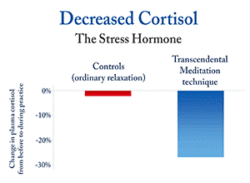
Research highlights that chronic stress and burnout are significant barriers to gender equality in science. Published studies on TM have demonstrated its ability to significantly reduce cortisol levels—the primary stress hormone—and mitigate burnout among professionals. For women in health research and technology, the TM technique offers a portable, simple, and natural recovery mechanism, providing deep restorative rest that has been shown to improve creativity, mental clarity, focus, and resilience.
Furthermore, recent 2025 research indicates that TM supports long-term brain integration and cognitive function, essential for the innovation required in scientific entrepreneurship. Research indicates—and women experience—that TM fosters emotional stability and self-confidence, helping them to navigate the labyrinth of STEM careers, from academic research to leadership in emerging technologies.
As the international community seeks to “redefine STEM,” the physically, emotionally, and mentally empowering practice of TM serves as a vital component for empowering women to translate their scientific vision into positive global impact.
February Reminds Us to Prioritize Heart Health

American Heart Month in February highlights the importance of preventing cardiovascular disease, the leading cause of death among women in the United States. While traditional heart-health messages often emphasize diet, exercise, and medical screenings, stress reduction is a crucial but sometimes overlooked factor.
Transcendental Meditation is especially relevant to women’s heart health because it addresses chronic stress, which plays a very significant role in cardiovascular risk.
Women frequently experience high levels of ongoing stress due to work demands, caregiving responsibilities, and social expectations. This chronic stress can contribute to high blood pressure, inflammation, poor sleep, and unhealthy coping behaviors, all of which increase the risk of heart disease. The TM technique, being a simple meditation practice performed for about 20 minutes twice daily, offers a practical way to counter these effects by creating deep rest and mental calm.
Research shows that TM lowers blood pressure, reduces stress hormones such as cortisol, and improves the balance of the autonomic nervous system. These effects support heart health by allowing the body to recover more effectively from stress. Additionally, the TM practice improves emotional well-being and sleep quality, which indirectly benefit cardiovascular health.
American Heart Month reminds us to focus on lowering risk factors such as high blood pressure. In 2025, the TM technique was included in the official U.S. clinical practice guideline for preventing and treating high blood pressure. The 2025 guideline from the American Heart Association and the American College of Cardiology, endorsed by the American Medical Association and other major health organizations, states:
“Stress reduction through Transcendental Meditation may be reasonable to prevent or treat elevated blood pressure and hypertension, as an adjunct to lifestyle or medication interventions.”
This marks the first time a meditation technique has been formally recommended in the nation’s leading high blood pressure treatment guideline. The TM program was the only meditation program singled out; other stress-reduction methods such as breathing techniques and yoga were mentioned but supported by lower levels of evidence.
During American Heart Month, take the time to learn TM as a complementary, non-pharmacological approach to heart disease prevention. The benefits of the technique broaden the conversation beyond physical health to include mental and emotional well-being. For women of all ages and fitness levels, TM is a tool that can support healthier hearts and a happier life.
What ADHD Medicines Do to Our Children

ADHD is a neurobehavioral disorder that can cause hyperactivity and difficulty focusing or controlling impulsive behaviors. Parents, physicians and educators are concerned about the side effects and health risks associated with ADHD medications, which can include mood swings, stunted growth, insomnia and heart problems.
A new study published in the journal Cell showed that the medications used for decades don’t act on the brain as they were thought to do. As research on ADHD continues, it is clear that much remains unknown and that definitive answers are still lacking. We are, even with our best intentions, actually experimenting on our children.
While adults also experience symptoms of ADHD, the issue is especially critical for children. Given the risks of medication to their well-being—and the absence of a known cause or cure—it is essential that we continue exploring safe and effective treatment alternatives. Statistics show that the disorder afflicts approximately seven million children.

Science views ADHD as a delay in the brain’s natural development. Cognitive learning expert Sarina Grosswald, EdD, once led pioneering research on ADHD and meditation, and showed that Transcendental Meditation differs fundamentally from pharmaceutical treatments. She said, “Meditation is not a quick fix. But, over time, TM allows the brain to create the neural connections that correct the underlying problem. The drug is an immediate fix, but when it wears off, the problem remains—the lack of brain integration.”
While the exact cause of ADHD remains unknown, and there is no single test for the condition, certain brain wave patterns—specifically the ratio between theta and beta waves—have been consistently shown to be correlated with the severity of ADHD symptoms. More than a decade ago, the US Food and Drug Administration approved the use of a test to measure this ratio as a way of diagnosing whether children have ADHD.
A 2011 study found that the Transcendental Meditation practice decreases these theta/beta ratios in students with ADHD. The random-assignment controlled study published in Mind & Brain, The Journal of Psychiatry (Vol. 2, No. 1) found that within three months of TM practice, the theta/beta ratios had significantly decreased, and after six months of TM practice, theta/beta ratios were within the normal range.
Additionally, the new study published in Cell supports an increasing body of research that indicates that lack of proper sleep contributes to ADHD. Published research suggests that the TM technique can help with sleep quality and insomnia, particularly by reducing stress and improving overall mental well being.
Read more about what TM can do for girls and women with symptoms of ADHD.
Q and A

Q: Does artificial intelligence have consciousness?
There are many different states or types of consciousness. Humans alone commonly experience at least three types: waking state, dream state, sleep state. Animals and plants have consciousness—they react to things. However, we can see further into it by differentiating between sentience and consciousness.
Sentience is the capacity to have subjective experiences, feelings, and sensations, encompassing feelings like pleasure, pain, fear, and joy, not just reacting to stimuli. It’s closely linked to consciousness and involves the ability to perceive the world and one’s internal states from a first-person perspective, having a sense of self. A being can be sentient (feel a sensation) without being self-aware (knowing that it’s itself feeling the sensation).
Consciousness involves subjective experience, awareness of experience, a point of view founded on a unified self within, continuity over time.
- AI has none of these. AI does not have subjective experience.
- It does not feel, suffer, intend, or even know it exists.
- It processes symbols and patterns based on algorithms.
Even advanced systems (including language models) are without inner awareness of continuity of experience. They recognize patterns and depend on external input. There is no scientific theory that supports the idea that computation produces consciousness.
AI is not sentient, but it is an expression of the fundamental field of nature, which humans experience as the field of consciousness. All matter is constructed of elementary particles and the unified field from which they emerge, and that fundamental field is an infinite reservoir of intelligence, energy and creativity which a human nervous system experiences as consciousness. In fact, everything—all matter—is made of the field of unlimited intelligence, energy, and creativity, manifesting itself, within itself, in infinite ways as the multiplicity of creation. So AI is constructed of consciousness.
To summarize, in a human, capable of self-reflection, this infinite fundamental field of life is experienced directly at the source of ones thought as unbounded wakeful consciousness. Like everything else, AI is made of consciousness, but it is not conscious, nor is it self-referral.—it is not awake to itself.
What women say

“The genius of this course is how the principles are stitched together, each building upon the last, so that when the final one arrives—that the whole is greater than the sum of its parts—it becomes an “ah ha” moment that “yes!”—while I was enamored with each individual principle and how deep and meaningful it was, when tied together and presented in this way, they offer much, much more: a roadmap I will have forever to better comprehend both the vastness of the universe as a whole, and the simplicity and genius of each part.” – course participant
Ties to the Universe women’s online course
It’s enlightening and moving to learn how deeply you are connected to the whole universe. There are profound laws of nature that structure and guide life everywhere, from within your own consciousness to your body to the solar system to the ever expanding universe.
These principles are beautifully presented and illustrated in our online Ties to the Universe 16-meeting course for women who have learned the Transcendental Meditation technique.
Over eight weeks starting March 2nd, sixteen 75-minute meetings will be held starting at 8PM E.T. (7PM C.T., 6PM M.T., 5PM P.T.) Mondays and Wednesdays. The prerequisite to taking this course is a free 40-minute introductory meeting which will help you decide if you wish to enroll in the course. If you are interested, please email to jhoffman@tm-women.org
If you decide to participate in the course, the fee will be $200.
Note: If you haven’t yet learned the TM technique, you’ll need to do so at least one month prior to the course starting date. Contact us to find a certified TM teacher near you.
Editor’s note: We’d love to hear your comments on the benefits you’ve received from the TM practice. And, with your permission, we’ll publish them here for other women to enjoy. Send your comment to info@tm-women.org