The Extraordinary Pianist Hiroko Sasaki: Silence in Performance
An Interview by Janet Hoffman
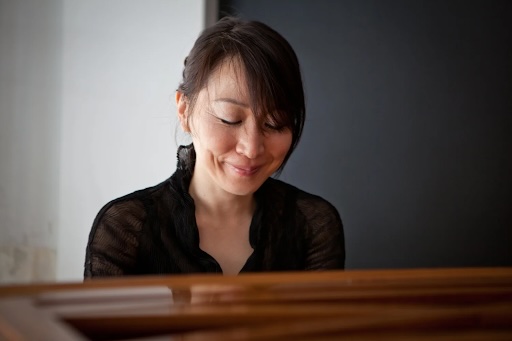
Internationally acclaimed pianist Hiroko Sasaki has earned recognition for performances distinguished by expressive depth, profound musical sensitivity, and technical brilliance. Born in Japan, Hiroko has appeared as a soloist with major orchestras and in recital throughout North America, Europe, and Asia, captivating her audiences. In addition to her performing career, Hiroko is an educator who has inspired many young musicians through her teaching and mentorship.
Hiroko Sasaki practices the Transcendental Meditation technique, which she credits with enriching both her professional and personal life. In this interview, she reflects on how developing inner silence through the TM technique has influenced her performances, experience and love of music.
Janet:
Hiroko, such a pleasure to be able to speak with you! Can we start by talking about how you came to learn the Transcendental Meditation technique?
Hiroko:
I knew nothing about TM whatsoever. I didn’t know who Maharishi was, his connection with the Beatles, nothing. Except that I am a huge fan of David Lynch. One weekend, I decided to do a David Lynch marathon on Netflix—it was clearly before I had kids that I had time to do that, lol! I watched all his movies that were on Netflix, and when I ran out of movies, there was one documentary left. It was about Lynch and TM, and the TM program he implemented in a public school. The way Lynch talked about his experience with TM was just mind-blowing to me. And learning about all the scientific results, and how TM had affected the children’s growth.
After seeing that documentary I thought, “Well, if it’s good enough for David Lynch, it’s good enough for me!! lol” So I Googled TM and called the NYC TM Center immediately. And they told me that the cost at that time of learning TM was $1,500. So I hung up the phone. lol. I thought, “What is this, a scam?” But I just couldn’t forget about what David Lynch said about TM. So I called back and they explained, “Look, this is a nonprofit organization. There is an introductory class and that’s free. Why don’t you just come take it and see?” And so that’s when I went, and what I learned about TM was so convincing I signed up to learn right away. So that’s how my journey with TM started.
When I first learned TM—this was 2013—I remember thinking, wait, it can’t be this easy. But when I went out the door of the TM Center building onto the streets of New York City, I noticed just how loud the city noise was, as if I was noticing this for the first time, and yet I had lived there for over 10 years already. It was as if the meditation I just learned had put me in a place of silence, and I wasn’t even aware.
During the following months, whenever I meditated I felt like my brain was releasing all kinds of happy chemicals. In fact, I was not very happy that one can only do TM twice a day! I knew I would be like Lynch—that I would never skip a day of this for the rest of my life. I got pregnant shortly after with my first—my son was born in June of 2014. I even went to a retreat for people who had learned TM—which was a 5-hour train ride away—during my first trimester. But this is one thing that is different about being a woman—we have to go through a lot of biological changes in ways that men don’t. And that complicates a lot of things, including the daily routine of meditation, unfortunately.
Janet:
Were there benefits that made it an important part of your life? You just talked about some of your earliest experiences—the happiness that you were filled with and you wanted to do it all the time. Were there other benefits that were tangible enough that you could put your finger on them?
Hiroko:
Yes! I do remember that around three weeks after I first learned to meditate, my husband and I stopped fighting. Like, completely! And it was shocking because we’ve always had a very volatile, emotional chemistry. That was the only period that ever happened just like that and for any length though lol.
One thing I would say is that for me personally, for my art—and, I believe, for a lot of artists—I need silence within. We need to find that space inside of us, because that silence is where everything starts, where things are born from. I know when I’m playing well, I have perspective, and my sensory awareness is vast. Like I’m still myself engaged in what I’m doing, but at the same time, I’m aware of everything—how the physical space feels around me, the distance and sense of where I am in the space, but also beyond the space to outside and somehow to the vastness.
When I’m not playing well, I’m just all very closed up. You know, I’m not even aware that I’m not aware of the surroundings, and I’m like just all in my body. And I’m trying really hard. Nothing feels easy. I can have periods like that. And when I’m like that—I guess you can say, one is blocked or in the funk—I always complain to my husband, “I can’t play the piano right now because I’m not in touch with God!” He has heard this from me over the years, a lot!! Lol.
Janet:
That’s a beautiful explanation. Can you elaborate on this?
Hiroko:
I’ve had experiences of being in the zone. The very first time was before I learned TM. I was 17 and it was a big-deal performance, as a soloist with The Philharmonia Orchestra in London at St. Paul’s Cathedral. I worked so hard for this. But then, on the day of the performance, I had a huge fight with my piano teacher (about nothing musical lol)! It was dramatic and I cried. So I felt like, oh boo hoo, who cares about the performance!—perhaps this feeling liberated me somehow. As I went on stage that evening and began to perform, I experienced what it is to be in the zone. I will never forget this feeling—it felt as if someone else was performing for me—like, I was doing nothing. I mean, I was fully there and felt the excitement of performing, but there was no effort made on my part. I had practiced that music—Mozart piano concerto—over and over, for months, many hours a day. Yet I was truly hearing this music for the first time in my life. I sat there performing, as the music literally unfolded before me, and I just admired the beauty of it. “Oh my God, what beautiful music this is!!”—was how I remember feeling on stage.
I felt that I was the performer and the observer at the same time. I was so truly touched by the beauty of the music, and I knew that the audience was also. Because what I felt was real and sincere. And it came from the right place.
Of course, this type of experience is rare. But this silent place that I often reach when I meditate, I know it’s the same place I went to when I was in the zone. And with daily practice of TM, I feel that this part of me grows more and more. In recent years, I feel that it is actually quite available to me on demand, not just accidentally, but that it is easier for me to reach this silence and perspective, especially on stage performing. With music in general, actually, I feel that there are similarities between playing music and meditating.
Once, right after I got back from a TM retreat, I went to a concert of a wonderful pianist playing Beethoven sonatas and I began transcending just listening to the music.
Janet:
Yes, some other performers describe moments when the music seems to play itself. The growth of consciousness from TM influenced your ability to enter those effortless states of performance.
Hiroko:
Yes, in fact, when I watch videos of my recent live performances, I notice how still my body is. I almost don’t move at all. Like there is a center, and because I’m listening to what comes from the silence, and for that, I need to be still. It’s not anything that I’m trying to do. It is just happening. This is fairly new to me—I would say, the last few years? And I don’t rush, at all. We musicians can develop all kinds of habits, or do things when we are nervous, or physically tense. And one of the most telling things is: you tend to rush. I mean, the tempo of music can get unintentionally faster. I just don’t rush anymore. In fact, I don’t get nervous much anymore. I know that if I can react to the music for what it is, then there is nothing else to be done. So I enjoy. I’ve done all the work I could, so let go and let God—or something like that lol. Just go along for the ride!
Janet:
Really beautiful. And what about more ordinary benefits from TM, such as reduction of stress?
Hiroko:
Well, in general, it reduces stress and it gives me calm. Again, because I feel that TM helps me have perspective. It gives me certain space before reacting. I feel more objective. Also I feel more naturally myself, and this is a good feeling, to feel ok being who you are. It is easier with music than in life though!!
Janet:
If you could speak to your younger self at the beginning of your musical career, what would you tell her?
Hiroko:
Maybe just the importance of connecting with people and keeping the connection potential. I feel more and more how much I appreciate friends I have around. How much it means to be surrounded by people that you can connect to, and that love you for who you are. I feel very blessed in this way—it is honestly the most important thing in life. I also feel grateful to have met so many amazing people through TM who are on a similar path—in search of something larger than ourselves in life.
Janet:
What would you say to a young woman hoping to make a career playing the piano—or any musician really. Any advice or wisdom you would impart to them?
Hiroko:
I think being a woman is difficult in the sense that you have a choice to be a mother. I think that is the biggest difference between women and men, you know, because women have three choices. A woman can give up her career and be a mother, or just decide not to be a mother and pursue her career, or she can try to do both. (I guess there is another path of not deciding….) And I think that there’s not one winning path here. It’s difficult. I personally find it so difficult to do both, as neither seems possible without my full attention. I tend to become one or the other, and balance seems almost impossible to find.
But one thing I have learned—you do need to be your true self, to take care of yourself, or it is a sinking ship. Daily practice of TM is the way I take care of myself. Even though it feels like there is never enough time, I try to make time to go to TM retreats. My husband supports me on this because he sees the benefit I get from TM, and I appreciate that. Somehow I need to convince him to learn it himself!
Find Inner Silence
About the Author
Janet Hoffman is the executive director of TM for Women Professionals, a division of TM for Women in the USA
More Posts by Janet
- The Story of Hurricane Helene and the Relief From Within Project: An Interview with Jeanne Ball
- Beauty and Joy, Even When the World is Too Much
- Our Inner Advantage in an Unsettling World
- An Interview of Dr. Amy Knoblock-Hahn: Advancing Health Through Nutrition and Lifestyle
- This Summer, Let TM for Women be Your Travel Guide to the Ultimate Stay-cation