A Simple Guide to Healthy Happy Mothers and Babies: An Interview with Author Margaret Mullins
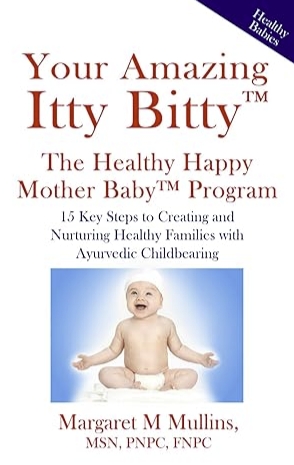
Margaret Mullins MSN, PNPC, FNPC is the longtime steward of the Healthy Happy Mother & Baby Program and the author of a new book by that name. Drawing on decades of experience in both Western obstetrics and Maharishi AyurVeda, Margeret has played a central role in preserving—and responsibly sharing—this specialized body of maternity care for modern families and practitioners.
Q: Your Amazing Itty Bitty is the publisher of your new book, The Healthy Happy Mother & Baby Program. What inspired you to write this book now?
My first book is now out of print, and it focused primarily on the postpartum period—supporting a mother’s recovery after birth. This new book is intentionally short, accessible, and practical, and it expands the lens to include the entire childbearing journey: preconception, pregnancy, labor, delivery, and postpartum.
I chose this publisher because they specialize in creating clear, inviting introductions for the general public. My hope is that readers will feel guided rather than overwhelmed—supported step by step—and introduced to even deeper aspects of this integrative approach to childbearing in a way that feels doable and relevant.
Q: For readers who may be unfamiliar, what is Maharishi AyurVeda?
“Veda” means knowledge—the knowledge of life in its totality and in its details. Ayurveda, which is at least 6,000 years old, is the oldest continually practiced system of healthcare in the world.
Maharishi Mahesh Yogi, the globally renowned founder of Transcendental Meditation, restored multiple aspects of this ancient Vedic knowledge that had been lost or fragmented over time. His contribution was not only the revival of classical pure Ayurveda, but also the restoration of development of consciousness as a foundational element of health and healing.
Q: What is the Healthy Happy Mother & Baby (HHMB) Program?
The HHMB Program is a natural, holistic system of care that supports every phase of the childbearing journey. It draws from the extensive knowledge within AyurVeda and includes guidance on daily routines, diet and food preparation, herbal support to nourish all tissues, techniques for managing stress, and the practice that helps align individual consciousness with universal consciousness.
At its heart, it is about creating the most nourishing environment possible—for both mother and baby.
Q: Why does the program place such strong emphasis on the mother’s experience during pregnancy?
Because the mother and baby are not separate—they are one. The mother’s experience is the baby’s experience. When we care deeply for the mother, we are simultaneously caring for the baby. Supporting her physiology, emotions, and overall wellbeing is the most direct way to support healthy development.
Q: How does the Transcendental Meditation (TM) practice support a mother during pregnancy and in the early years of her child’s life?
There are hundreds of published research studies documenting the benefits of TM across many areas of mental and physical health, as well as for relationships, communities, and society. Speaking personally as a mother, I find its effects on vitality, mental clarity, and stress reduction to be especially valuable.
Parenting is endlessly rewarding—and also demanding. The ability to restore one’s energy and refresh the mind is an extraordinary gift. TM allows me to meet daily challenges with greater resilience and still feel exhilarated by the journey. It helps me bring my best self to my children, to my grandchildren, and to family life as a whole.
Q: You’ve been described as a key steward of this knowledge. What has that role meant to you?
I consider it a great honor to represent Maharishi Ayurveda, and especially the Healthy Happy Mother & Baby Program. I truly feel that Mother Nature set me on this path, and I am deeply grateful.
I am especially devoted to this work because, in my observation and experience, mothers and children are often not receiving the care they truly need and deserve.
On a personal note, when I was 12 years old my family was deeply affected by multiple serious health challenges. I learned TM at age 20, and over time it restored my health and helped heal my family—and many others. Sharing the HHMB knowledge feels like a way to pay forward what I was given.
Q: There is growing awareness that nourishment, emotional wellbeing, daily rhythms, and stress levels influence a baby’s development—even before birth. Does HHMB offer guidance that is both ancient and relevant?
Absolutely. While Ayurveda is ancient, it is profoundly relevant to modern life. Today’s pace is fast and relentless, and having access to time-tested, natural guidelines is not only supportive—it can be essential.
Western medicine offers remarkable high-tech solutions, but that is not always what is most needed. Ayurveda’s encyclopedic understanding of diet and daily living brings a depth of insight that can enhance every stage of childbearing, while also supporting the long-term health of the infant and growing child.
We are also learning more about fetal health and the neurotoxic effects of common environmental contaminants. The impact of these pollutants on the developing nervous system—both before and after birth—is only beginning to be understood, making preventative, holistic care more important than ever.
Q: A baby’s life is not something to manage so much as something to support with care and respect. What do you hope readers will take away from your book?
Maharishi often said, when asked about people’s actions, “It’s a choice, it’s a choice.” This small introductory book is meant to expand the choices available to prospective parents—choices that support both their own wellbeing and that of their children.
Life is a precious gift. Let’s enjoy it.
Learn the TM technique to nourish yourself and your child. Contact a certified TM teacher. And buy the book on Amazon.
About the Author
Janet Hoffman is the executive director of TM for Women Professionals, a division of TM for Women in the USA
More Posts by Janet
- Author Ann Purcell Discusses Silence
- Five Fundamentals of Progress: A Scientific Path to Self-Improvement
- Advice You Can Rely On: How to Leverage Your Body’s Innate Healing Ability
- Saving the Ocean from Deadly Noise Pollution: An Interview with Kathy Matara PhD
- The Omnipresent Nature of Consciousness